 The Good Part
Why Honey Never Spoils
Archaeologists excavating ancient Egyptian tombs have often turned up something unexpected among the artefacts: pots of honey, thousands of years old and still preserved. In 2015, scientists found a 3,000-year-old pot of perfectly preserved honey in Egypt. Samples of honey from archaeological contexts have proven edible even after millennia, and the reasons start inside the bee.
How bees turn nectar into honey
A foraging honey bee sucks nectar through its proboscis into its honey stomach, which in Apis mellifera holds about 40 mg of liquid, roughly half the weight of an unladen bee. Filling it can take visits to more than one thousand flowers and more than an hour of ceaseless work. Enzymes from the bee's hypopharyngeal gland then begin cleaving sucrose and starches into simpler sugars such as glucose and fructose.
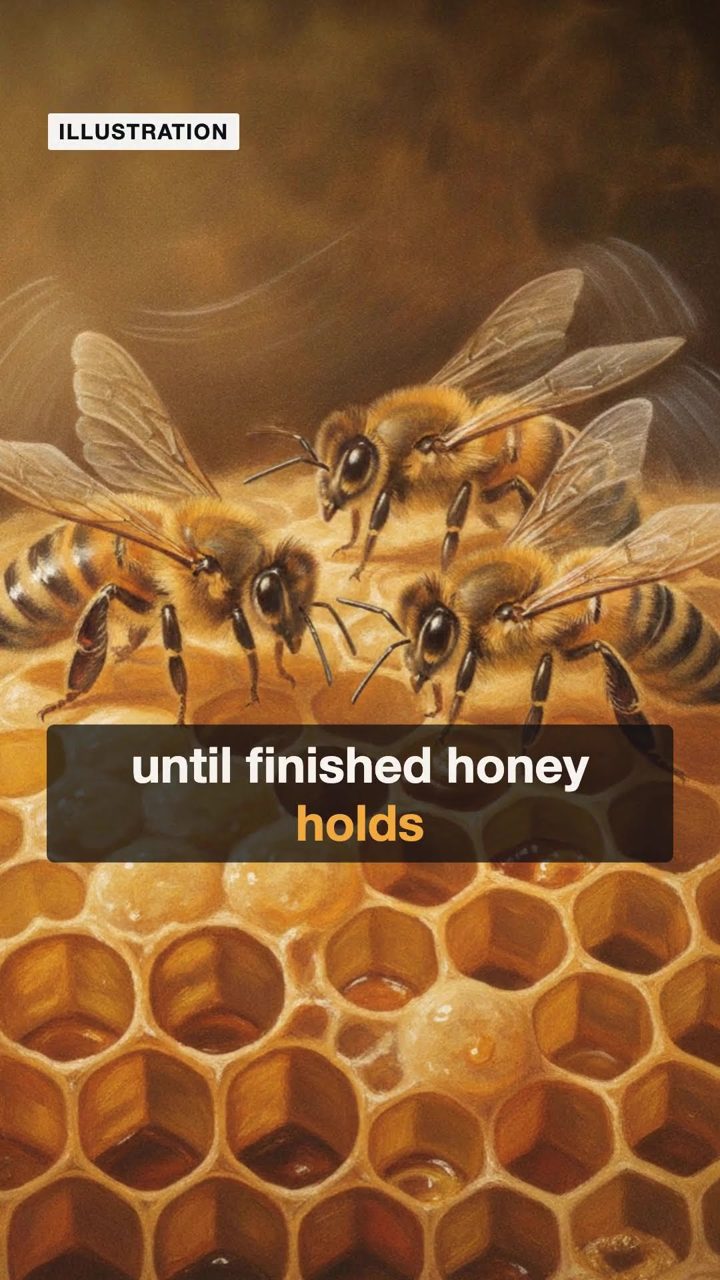
Back at the hive, foragers pass the nectar to hive bees, which work in relay, repeatedly forming bubbles between their mandibles to evaporate water into the warm hive air. This can take as long as 20 minutes before the product reaches storage quality. The new honey goes into uncapped cells while still holding up to 70% water, enough for yeast spores to reproduce, so the bees generate their own heat to keep drying it.
Evaporation continues until the honey holds between 15.5% and 18% water, compared with 70 to 80% in flower nectar. That leaves a supersaturated solution of sugars, with far more sugar dissolved than water could normally hold. The bees then cap the cells with wax, sealing out contamination and stopping further evaporation.
Three barriers against microbes
Such high sugar concentrations are, for osmotic reasons, extremely unfavourable to microbial reproduction. Amina Harris, executive director of the Honey and Pollination Center at the University of California, Davis, puts it bluntly: microorganisms in honey "just die. They're smothered by it, essentially." Honey is also acidic, with a pH between 3 and 4.5, approximately.
Molasses shows why those two factors alone fall short: it is hygroscopic and acidic, with a pH of around 5.5, yet it eventually spoils. The difference comes from glucose oxidase, an enzyme bees mix into the nectar. It produces gluconic acid and hydrogen peroxide, which partly account for honey's acidity and its suppression of bacterial growth.
Why the lid matters
Sugars are hygroscopic, so unsealed honey readily draws in moisture. As long as its water content does not rise much above 18%, honey has an indefinite shelf life, but once water exceeds 25%, bacteria can move in again. One quality test reflects this: when poured, good honey forms small, temporary layers that disappear fairly quickly, and honey that fails to do so has over 20% water and is unsuitable for long-term preservation.
Crystallisation is a separate matter and does not mean spoilage. Supermarket honey is heated and strained to remove particulates, while honey from small vendors may keep pollen and enzymes and crystallise. Below 5 °C, honey will not crystallise at all.
From clay tablets to hospitals
Sumerian clay tablets from approximately 2100 to 2000 BCE record honey treating burns and cuts, and state it was used in 30 percent of prescriptions. Ancient Egyptians made honey ointments for skin and eye diseases. The Dutch scientist Bernardus Adrianus van Ketel first demonstrated honey's antibacterial effects in 1892.
The rise of antibiotic-resistant bacteria has renewed research interest, with methylglyoxal, hydrogen peroxide and royalisin under preliminary study. Honey-covered MEDIHONEY bandages are already used in hospitals around the world. The chemistry that keeps a tomb pot edible may yet help fight infections that modern drugs struggle to treat.
Where this comes from
- The Science Behind Honey’s Eternal Shelf Life
- The Science Behind Honey Never Becoming Spoiled
- Honey - Wikipedia
- Here's Why Honey Never Expires
The narration is a synthetic voice; pictures are archive photographs or illustrations we generate, never of real people.