 The Good Part
The Planet That Would Float: Saturn Is Less Dense Than Water
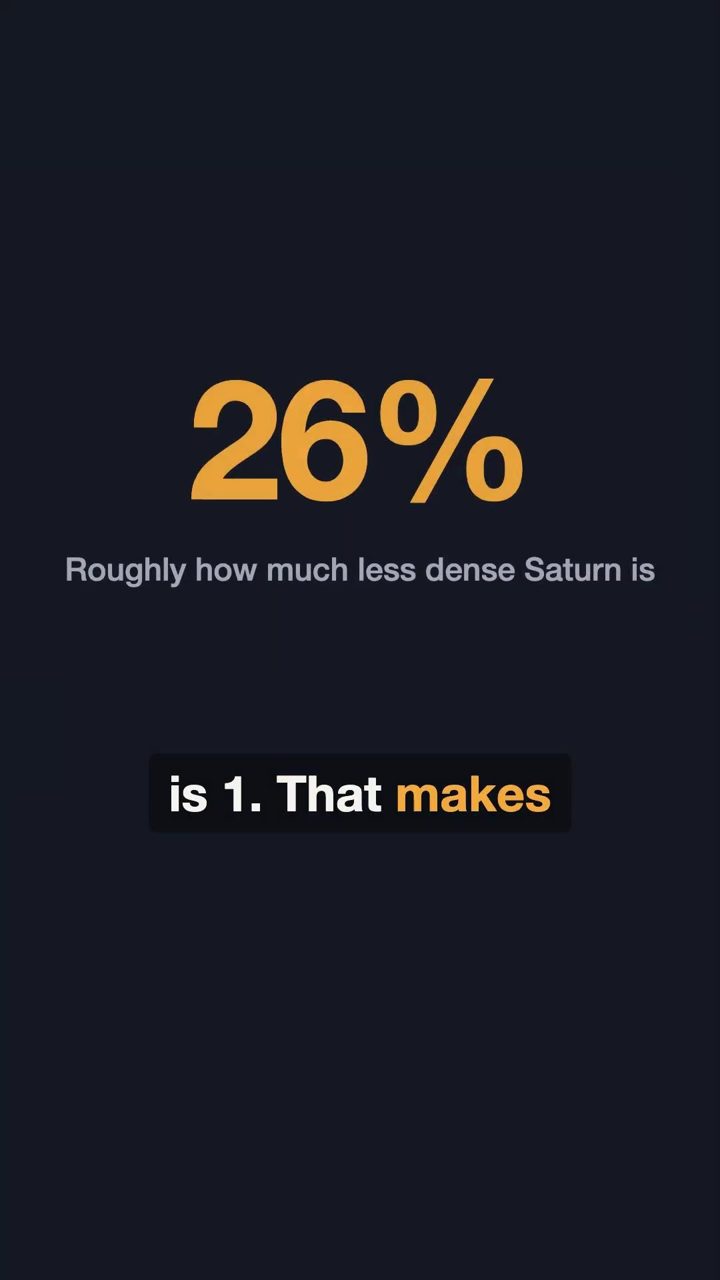
Saturn is the second largest planet in the Solar System, yet it is less dense than water. Its average density is 0.687 grams per cubic centimetre, against 1 gram per cubic centimetre for water. Some sources use a slightly more precise figure for water, 0.997 grams per cubic centimetre, but the conclusion holds: Saturn is about 30% less dense than water, and it is the only planet in the Solar System of which that is true.
Light gases, enormous volume
The explanation lies in what Saturn is made of. It is a gas giant composed mostly of hydrogen and helium, the two lightest elements in the Universe. Those gases weigh little, but Saturn is enormous, with a diameter about nine times that of Earth.
Density compares mass, the amount of matter in an object, with volume, the space it occupies. Saturn holds 95 times the mass of Earth, but it spreads that mass across such a huge volume that its average density is only an eighth of Earth's. The comparison with Jupiter is just as telling: Saturn is almost as big, yet it has less than a third of Jupiter's mass, since Jupiter weighs in at 318 times Earth.
Even so, the two giants dominate the planetary family. Together, Jupiter and Saturn hold 92% of the total planetary mass in the Solar System.
What lies beneath the clouds
Saturn has no definite surface. Its outermost layer spans about 1,000 km of gas, which gives way to liquid molecular hydrogen saturated with helium, then to a thicker layer of liquid metallic hydrogen. At the centre sits a core that reaches 11,700 °C.
Nobody can see that core, so scientists work it out indirectly. By examining Saturn's gravitational moment alongside physical models of the interior, they estimated in 2004 that the core must be between 9 and 22 times the mass of Earth, corresponding to a diameter of about 20,000 km. Measurements of the rings suggest a far more diffuse core, with a mass of about 17 Earths and a radius about 60% of Saturn's whole radius.
The interior also runs hot, and Saturn radiates 2.5 times more energy into space than it receives from the Sun. One proposed source is helium raining out as droplets deep inside, releasing heat by friction as they sink through the lighter hydrogen.
Gravity, spin and the bathtub
For all its mass, Saturn's size keeps its gravity modest: NASA puts it at about 1.08 times Earth's. Rapid rotation flattens the planet, so its equatorial radius of 60,268 km is more than 10% longer than its polar radius of 54,364 km. At the equator, the bulge and spin together bring the effective surface gravity down to 8.96 m/s2, which is 74% of the polar value and lower than Earth's.
Saturn is 116,460 km wide, so a bath to hold it would need to be about 120,000 km across. Even then, it would never really work. That much water would be too dense to stay liquid, and Saturn's gravity would pull the water in and destroy any pool built around it.
Why the floating planet matters
Saturn's low density makes visible a basic split in the Solar System. The gas giants of the outer regions are far larger than the rocky inner worlds yet far less dense, because they are rich in light elements while the rocky planets contain more heavy metals. Saturn sits at the extreme of that pattern, and the imaginary bathtub turns an abstract number into a picture of how planets are built.
Where this comes from
- Saturn, the enormous gas giant, could float on water (if you could find a big enough bathtub) | BBC Sky at Night Magazine
- Saturn - Wikipedia
- Would Saturn Float On Water?
The narration is a synthetic voice; pictures are archive photographs or illustrations we generate, never of real people.